Quantum computers operate on qubits, the fundamental unit of quantum information
- A qubit is a unit of quantum information similar to a classical bit
- They exist as a superposition of the eigenvalues \(|0\rangle\) and \(|1\rangle\) on a 2D sphere
- Qubits are operated on by performing rotations on the vector in the sphere
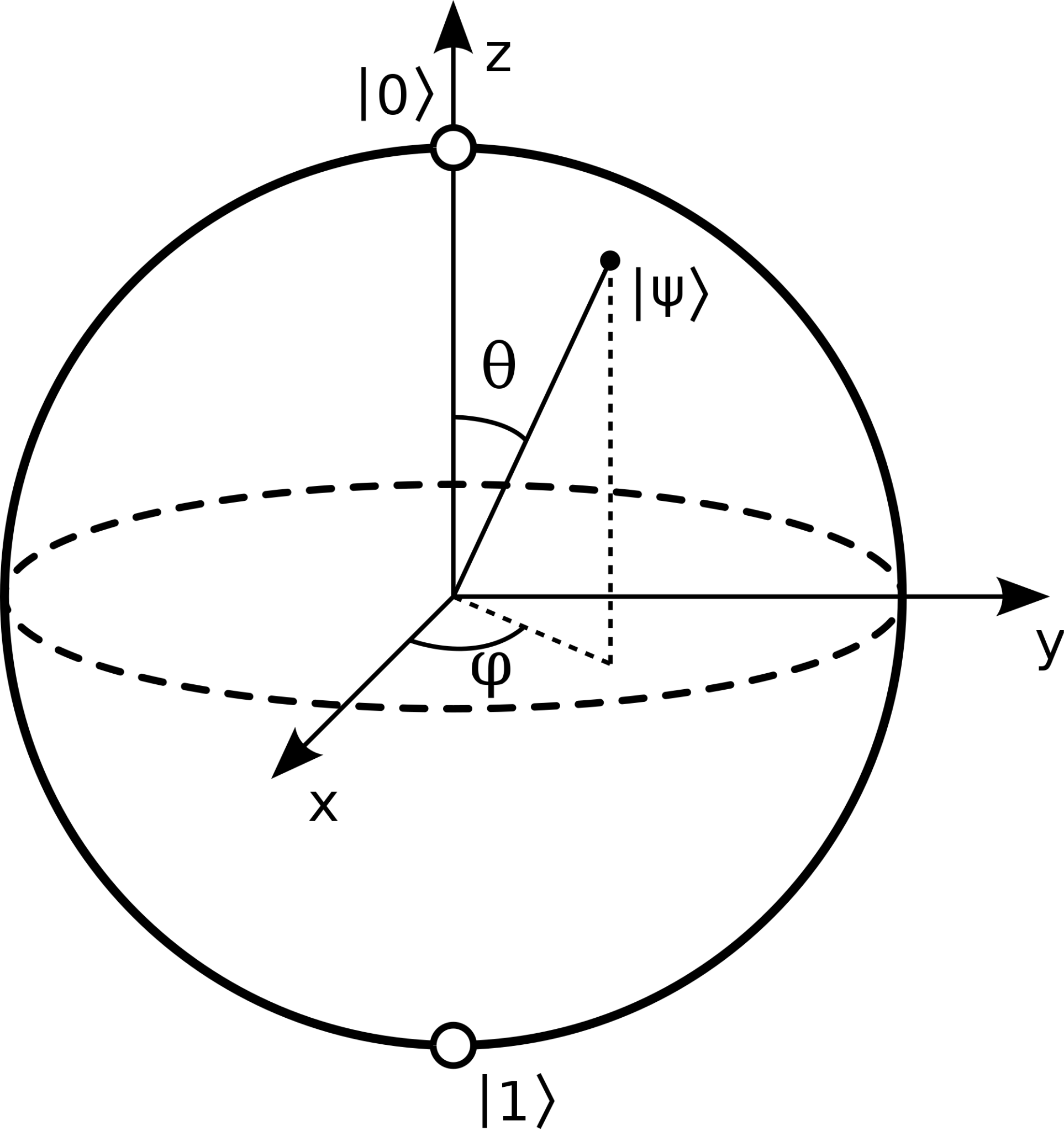
Quantum computers operate on qubits, the fundamental unit of quantum information
- Qubits are difficult to work with, they decohere (lose their state) extremely quickly
- Qubits can interfere with each other
Classification of data is done by creating hyperplanes in a high dimensional Hilbert space
- Each piece of data is embedded as a point in a Hilbert space
- \(n\) qubits form a \(2^n\) dimensional Hilbert space
- Hyperplanes are used to classify the embedded data
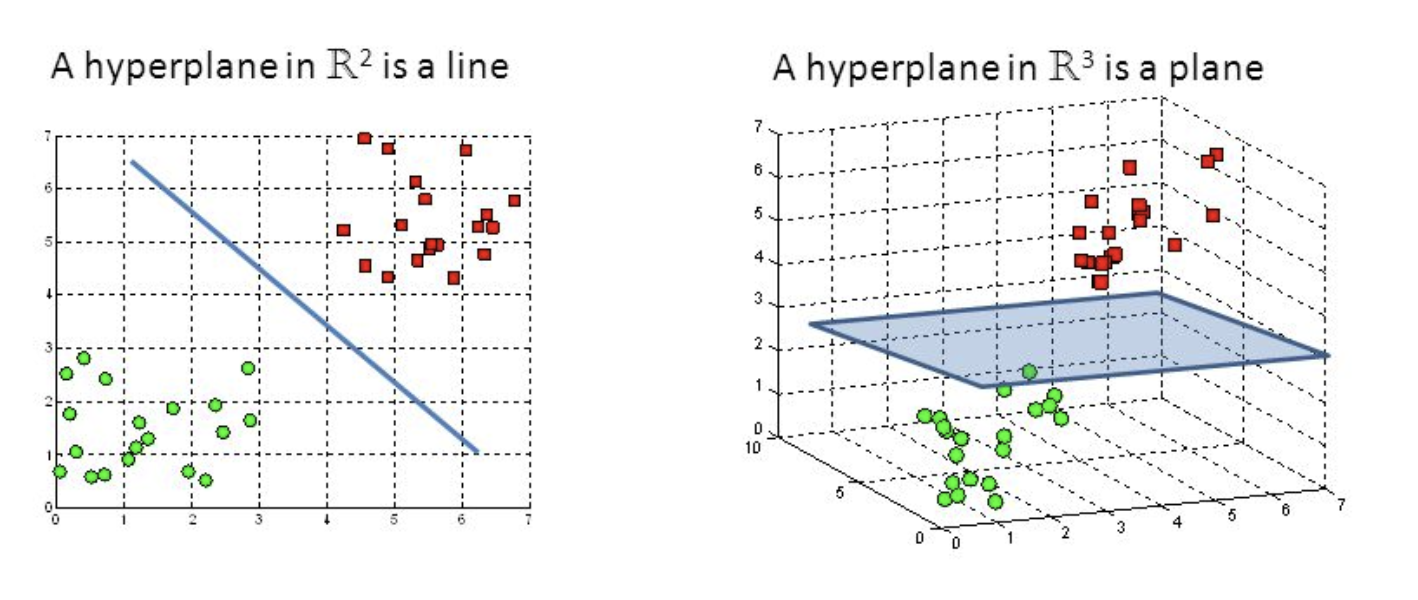
Two complementary approaches to quantum machine learning
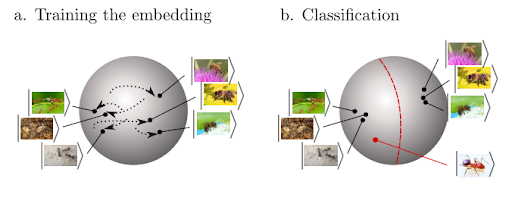
Quantum Metric Learning
- Training is done to optimize the embedding
- The classifier is analytically chosen after training
Variational Quantum Classifiers (VQCs)
- Classifier is a parametrized variational quantum circuit
- Similar to traditional machine learning
- The embedding is only weakly trainable
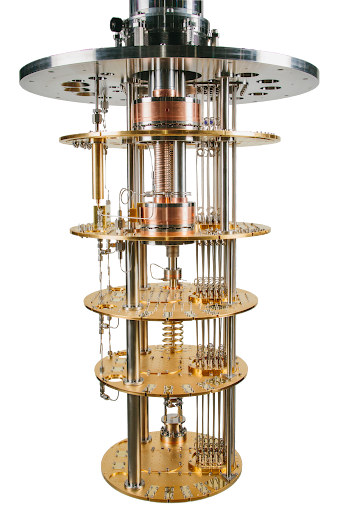
Neural embedding networks are too large for NISQ computers
- Noisy intermediate scale quantum (NISQ) computers only permit limited depth due to qubit decoherence
- Network scales cannot get large enough to make VQCs alone effective
- Qubit decoherence times are on the order of 1ms
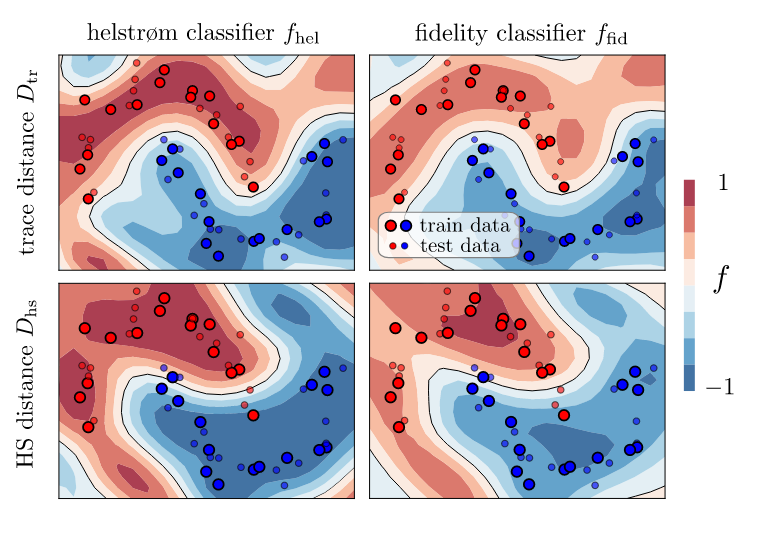
Quantum metric's loss function is a distance metric
- Metric learning aims to:
- Maximize distance between unrelated data (Maximize trace distance)
- Minimize distance between related data (Maximize fidelity)
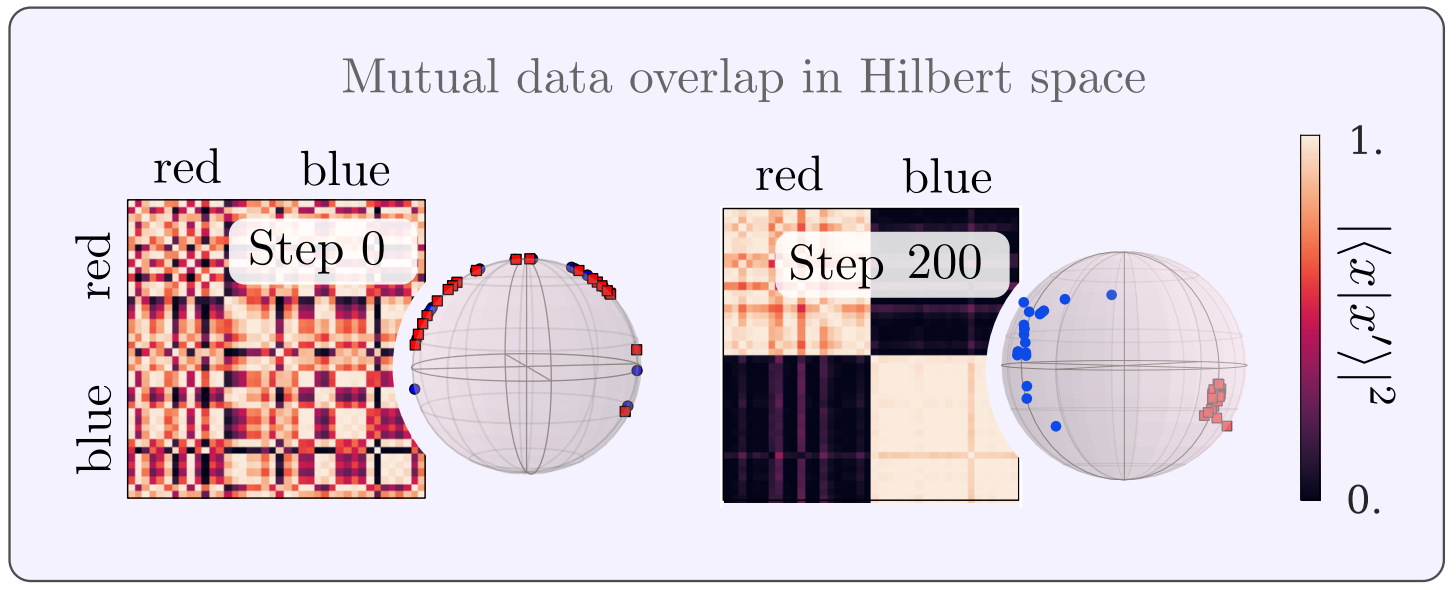
The efficacy of a quantum embedding is measured by performing a SWAP operation to find the fidelity. Trace distance is measured directly
Fidelity
- How tightly data is clustered
- \(F = |\langle\phi|\psi\rangle|^2\)
Trace distance
- How far apart data clusters are
- \(D_{\text{tr}}(\rho, \sigma) = \tfrac{1}{2} Tr[\rho - \sigma]\)
The SWAP procedure is a simple quantum circuit that creates an interference pattern between the swapped and not swapped data. This is used to measure the fidelity of the data.